⋆⁺₊⋆ ☀︎ ⋆⁺₊⋆
Dryptosaurus
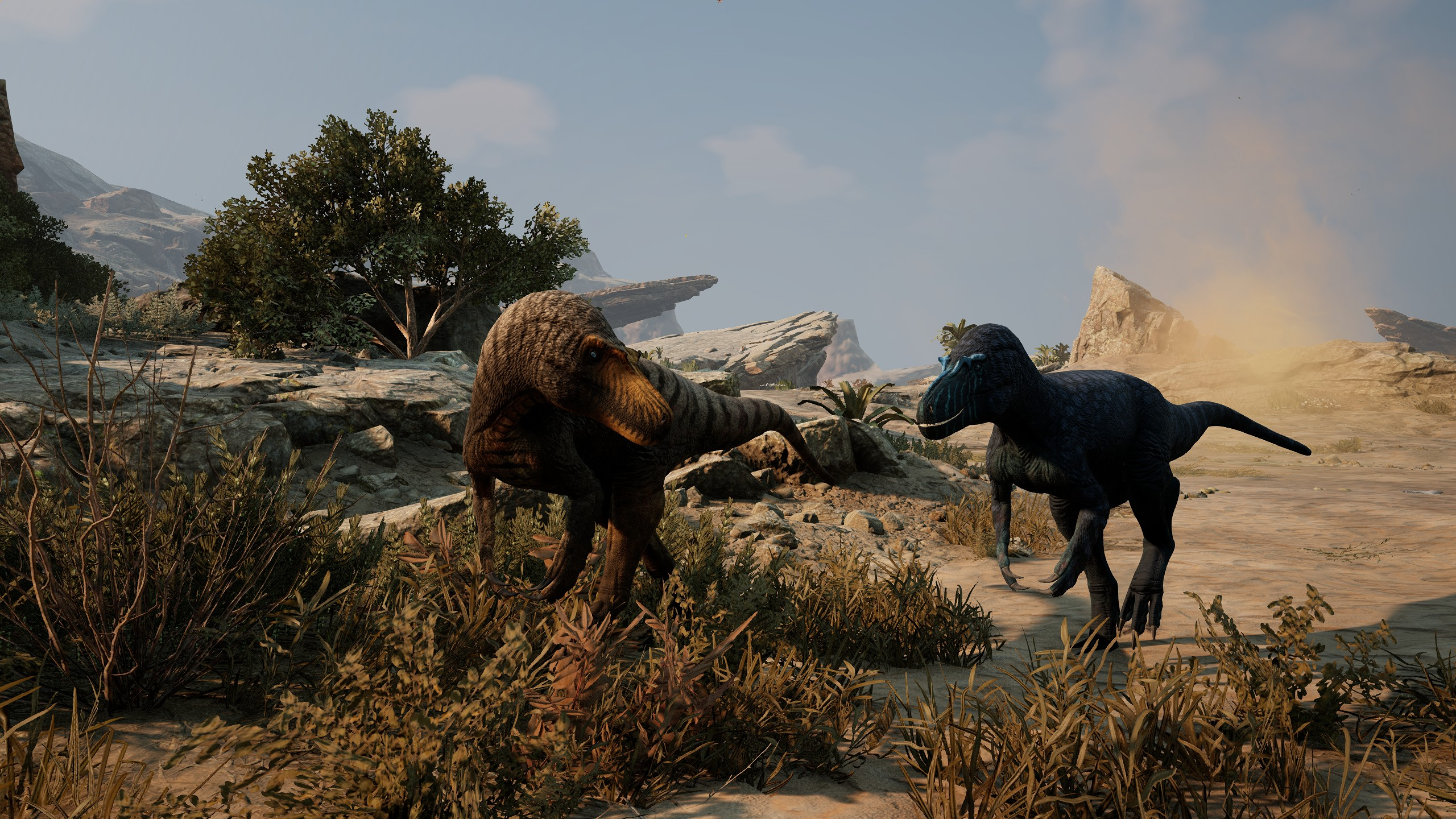
-
Highlights:
- Extremely adaptable hunters that learn from past mistakes that lead to fail hunts.
- Offspring are a handful for even the most experienced parents.
- Parents will boast about their offspring once it survived to a certain age.
⋆⁺₊⋆ ☀︎ ⋆⁺₊⋆
Group Limits
- Drift
- Up to 6 Adult/Sub-adults Dryptosaurus
- Drifts are made up of individuals that are either related/unrelated. They have no strict leadership, often fighting for the dominant role to be able to lead. The most dominant member is allowed to lead the group without challenge until either a new member joins or they fail multiple hunts causing their leadership to come into question.
- Drifts may have offspring present if they are related to at least one of the members.
- Muster
- Up to 10 Adult/Sub-adults Dryptosaurus
- Musters are made up of individuals that are all related towards each other, the only unrelated individuals have been mated into the family. They are led by the eldest of the family, typically the mother and father of every related individual but can be led by their eldest offspring if passed on.
- Musters consist of: 2 Elders, up to 8 Assistants, or 6 Assistants and 4 underlings
- Elders are the founding parents of a muster, assistants are direct offspring or mates to offspring of the elders and underlings are grandchildren or mates of the grandchildren. If great-grandchildren are had, they must disperse from the muster and start a Drift when reaching sub-adulthood.
- When mated into a muster, you gain the status of your mate.
- If one of the elders passes, the leadership role will go onto the eldest mated offspring and all of their direct offspring become assistants and siblings will become underlings and their offspring must disperse out of the muster. While the remaining Elder will become an assistant as well.
Nest Limits
- If in a Muster, Elders are always the first to nest, making sure their young gets the most care and resources before the rest of the family. For the rest of the family to nest, all of the elders eggs had hatched or no eggs had hatched.
- In a Drift, anyone may nest at any time.
- Blooming Season: 4 eggs, 3-hour Interval
- Scorching Season: 3 eggs, 4-hour Interval
- Wilting Season: 5 eggs, 3-hour Interval
- Wilting season is the peak season for Dryptosaurus, taking advantage of the cooler nights and warmer days with less rain driving prey to move more often.
- Frosting Season: 2 eggs, 5-hour Interval
- Only those in a muster may nest during the Frosting season as more members are around to help raise offspring.
Sexual Dimorphism
- Sexual Dimorphism is Mandatory
- Males are known as Shanks
- When greeting another Dryptosaurus, Shanks will look at them and judge their physical strength, almost sizing them up. They’re also warmer in color, possessing red, orange, and/or yellow feathers.
- Females are known as Shivs
- When greeting another Dryptosaurus, Shivs will lower their head letting out a friendly call before quickly hissing and spreading her arms showing her size. They’re also cooler colors, possessing blue, green, and/or purple feathers.
- Mutations
- The Battle damage subspecies is seen as a birth defect and is highly undesirable as a mate. Those with this subspecies are never chosen to court and never can become the leader of a drift or muster if born into a muster.
Habitat
- Nomadic
- Likes: Mountainous (except Whistling Columns), Deserts, Mesa expect for Titans pass, Hills, and valleys
- Neutral: Beaches
- Dislikes: Whistling Columns, Titans Pass, Dense Woodlands, Sparse Woodlands
Activity
- Cathemeral
- Dryptosaurus are always on the move, living in the more intense environments. When sleeping during the dawn and dusk, they get enough rest to continue on with the day or night to find resources.
- During downtime and every member has been fed, they may be seen taking a small nap for a few hours.
Diet
- General Carnivore, Food: Aggressive
- Dryptosaurus are not as picky, taking anything they can get in the harsh environments they live in. Often bickering with each other who gets to eat first on a corpse when in a drift or not sharing a pile of bones or other food sources. While Musters are more keen on sharing, the Elder always gets to eat first with the ones who also hunted before the rest of the muster.
- This aggressiveness does not stop at their own species, should they be challenged the more healthy members will aggressively defend the rights of their food and only back off if they become too hurt surrendering the body when too weak. Even then they may retreat to a safe distance before voicing their displeasure towards the new owners.
- They do not tolerate scavengers.
⋆⁺₊⋆ ☀︎ ⋆⁺₊⋆
Growing Behaviours
Hatchling
Hatchling Dryptosaurus are known as Blades.When hatching, Dryptosaurus are blind and begin to yell loudly, crying out for their mother and father, only calming when either of their parents touch their snouts with theirs.
Those who hatch quietly are considered weak and culled, and quickly are fed to their surviving siblings.
After being soothed by their parents, Blades lay where they hatch, resting from the exerting task of hatching, only moving when they hear their parents return with a meal.
Once nearing the end of hatchling, Blades begin opening their eyes. While sight is very limited, they begin exploring more around the nest, sniffing at their siblings and parents.
Juvenile
Juvenile Blades are now able to fully see, exploring their nest and siblings with a new found energy. Once all Blades are able to see, the drift or muster will begin moving again. Musters will herd the young into the middle of the group for better defence while the parents of a drift might try to keep their children between them, the rest of the group rarely cares about the blades.Blades are very much a handful, even for experienced parents. Always curious about their surroundings and poking their heads into places that shouldn't be, which parents have to come to their rescue if they are in danger.
Blades, when hungry, are exceptionally dangerous to their own well being, often not knowing they can’t eat food while it’s still *alive.* Often they will run after the first thing that looks like food and try to bite it to get a chunk. Parents will rescue wayward Blades and fetch them a suitable meal that's already dead. While their behaviour is exceptionally dangerous, it teaches them how to keep up with prey, so it is encouraged.
Adolescent
Once adolescent, these dangerous acts come to a halt as they begin to listen to their parents, not observing rather than acting. Because they successfully raised blades to this stage of life, Parents begin to boast, showing their young off to other members or other species that will look without trying to attack the family.Blades also begin hoarding items, often fighting with their siblings not wanting to share these items. This escalates towards food as well. Parents normally ignore these bickers unless they are dangerous to their survival. Blades aren’t also above bullying younger blades off food or items they want.
Parents or the muster will also begin teaching the blades how to hunt, hiding them nearby to be able to watch them. Some bolder blades may come out of hiding during the hunt but will never run over to engage. Instead they yell with excitement for the hunting party at the promise of a meal.
Sub/Adult
Once a Sub-adult, blades are considered Adults. They either stay within the muster or drift they were born into if there's room, or split off with their siblings to form their own drift, even if coming from a muster. If they split off from their parents, soft calls are exchanged between them, before touching snouts. If they’re splitting off from a muster and room becomes available after, if found again by their parents, they are welcomed to follow once again.Orphan Behaviours
- Orphan blades rarely get past hatchling, as they cry and cry for their parents touch but that will never come. They only really stop crying when they begin to see near the end of hatchling and realize that there's nothing around them.
- Even when Juvenile, with no parents stopping them, they begin to run up to things that look like food, before trying to eat whatever they run up too. While orphans make more mistakes on objects that don't remotely look like food, without the guidance from parents. Some can break teeth on hard objects like rocks. Some of these strange chewing habits could carry onto adulthood during desperate times, chewing on branches or roots.
- Once adolescent, if the orphans have survived this long, they are much quieter than those who grew up with parents. They also struggle learning how to hunt, usually quietly stalking after other carnivorous dinosaurs to learn how to hunt.
- When Sub-adult, Dryptosaurus are considered Adults. Those who grew up this way, however, might struggle socially, appearing more submissive in some or more aggressive and hard headed depending on the temperament and environment they grew up in.
Social Behaviours
- Both Shivs and Shanks are typically aggressive towards each other, especially in a Drift. Often testing each other multiple times before showing any respect towards them. Being strong is extremely important to Dryptosaurus, those who are seen as weak or submissive are pushed around often.
- Drifts are always shifting in dominance, each member always bickering with each other and finding where they stand in the hierarchy. However once an individual wins their right in fights to lead, they are respected by the members and not challenged again unless they cause multiple failed hunts. The only other time they are challenged by another member is if they are new to the group and trying to figure out where they fit into the drift hierarchy.
- Musters on the other hand dont fight for hierarchy but rather to keep their senses sharp. While those with the same ranking may also bicker to see who's stronger, they will never try and fight their parents for the Elder ranking, as that is earned through generations.
- Elders within a muster are a monogamous mated pair who had reached the proper requirements to start a muster. They are most likely related to all other members within the muster, except for those who had mated into the family. Elders also have the role of leading the muster into hunts and deciding hunting parties. They make the calls when to move to a new area or when a fight is worth fighting for. Due to being the main breeding pair, their offspring won't challenge them for the role and will hold high respect towards their parents.
- Assistants are offspring of the Elders or mates to the offspring. They are what makes up a muster, following and learning from their parents. They never fight their parents, but may fight each other to prove dominance between each other.
- Underlings are the grandchildren of Elders or mates of the grandchildren. They can not rank up to Assistants unless their parents become the Elders. Underlings are also usually the first to be pushed out to make room for the direct offspring and their mate if there is no room.
Interspecies Behaviours
- Dryptosaurus are not tolerant towards other species entering their personal space, attacking the invader if it doesn’t listen to its warnings.
- Dryptosaurus don’t avoid confrontation even if the threat is larger than them.
Territorial Behaviours
- Dryptosaurus aren’t territorial, but may accept challenges if challenged for territory.
Hunting/Hunted Behaviours
- Dryptosaurus like hunting Sub-apex and below, only attacking apex if they attack first.
- Dryptosaurus are very adaptable when hunting, often learning from past mistakes that they have made that led to failed hunts.
- Some Dryptosaurus prefer ambushing their prey before giving chase, while others may prefer just to run after their prey if it has spotted them.
- What will always stay the same, Dryptosaurus are stubborn and won't give up a hunt if they feel like they still have some kind of upperhand, usually in numbers. The only time it is given up is if they feel like they no longer have the upperhand, especially if most or all members of the hunt are extremely hurt.
- If hunted, Dryptosaurus will quickly defend themselves and each other, using loud calls and to disorientate their attacker so they can either escape or gain the upperhand.
Engagement Limits
- 3 per engagement with Sub-apex and below
- 4 per engagement with Apex tiers
Courtship
- When a Shiv becomes receptive, her change in behavior is immediate. She’ll go towards her preferred male(s) and constantly bother them, either by cooing softly or aggressively calling towards him.
- When a shank notices a Shivs doing this behavior towards him, and is interested in courting, he’ll coo softly before following her.
- Once she gathers the male(s) she's interested in leading them to an open field. Once in this more open area, the shanks will line up and begin postering, showing their strength and size towards the Shivs.
- Shivs are picky when choosing her mate, looking at every shank she has selected. Once she has made her choice, she’ll go up towards her chosen shank and nuzzle her snout against his.
- Once her choice is made she’ll hiss loudly towards the shank testing him in an actual battle. He must beat her for her to nest with him.
- Should he lose, the Shiv will refuse to nest with the shank and go back to testing other shanks.
- When a shiv is interested in making a life-long bond, she must have nested at least twice with two different shanks.
- When picking her shank, she’ll treat it like how she would normally pick her mate for nesting, but after he wins the fight, she’ll take him on a hunt when proper hunting hunger and they must hunt something medium or small and successfully hunt it before she decides that he's worthy enough to become her permanent mate.
- Once nesting each with each other, they become a permanent pair and every time they wish to nest, they must at least hunt something successfully to continue to prove their worth to each other.
⋆⁺₊⋆ ☀︎ ⋆⁺₊⋆
Notes
- For greetings, males will do the look around emote and females will do the heart emote before doing the teeth emote.
Terms
- Shiv = A Female Dryptosaurus.
- Shank = A Male Dryptosaurus.
- Blade = Any Dryptosaurus below Sub-adult.
- Drift = A group of Dryptosaurus that can be unrelated or related.
- Muster = A group of Dryptosaurus that are all related or unrelated that have mated in.
- Elders = The dominant mating pair of a Muster.
- Assistants = The direct offspring or mates of direct offspring to the Elders.
- Underlings = Any Dryptosaurus in a Muster who is not direct offspring or mates of direct offspring.
Stat Changes
- N/A
⋆⁺₊⋆ ☀︎ ⋆⁺₊⋆