⋆⁺₊⋆ ☀︎ ⋆⁺₊⋆
Hatzegopteryx
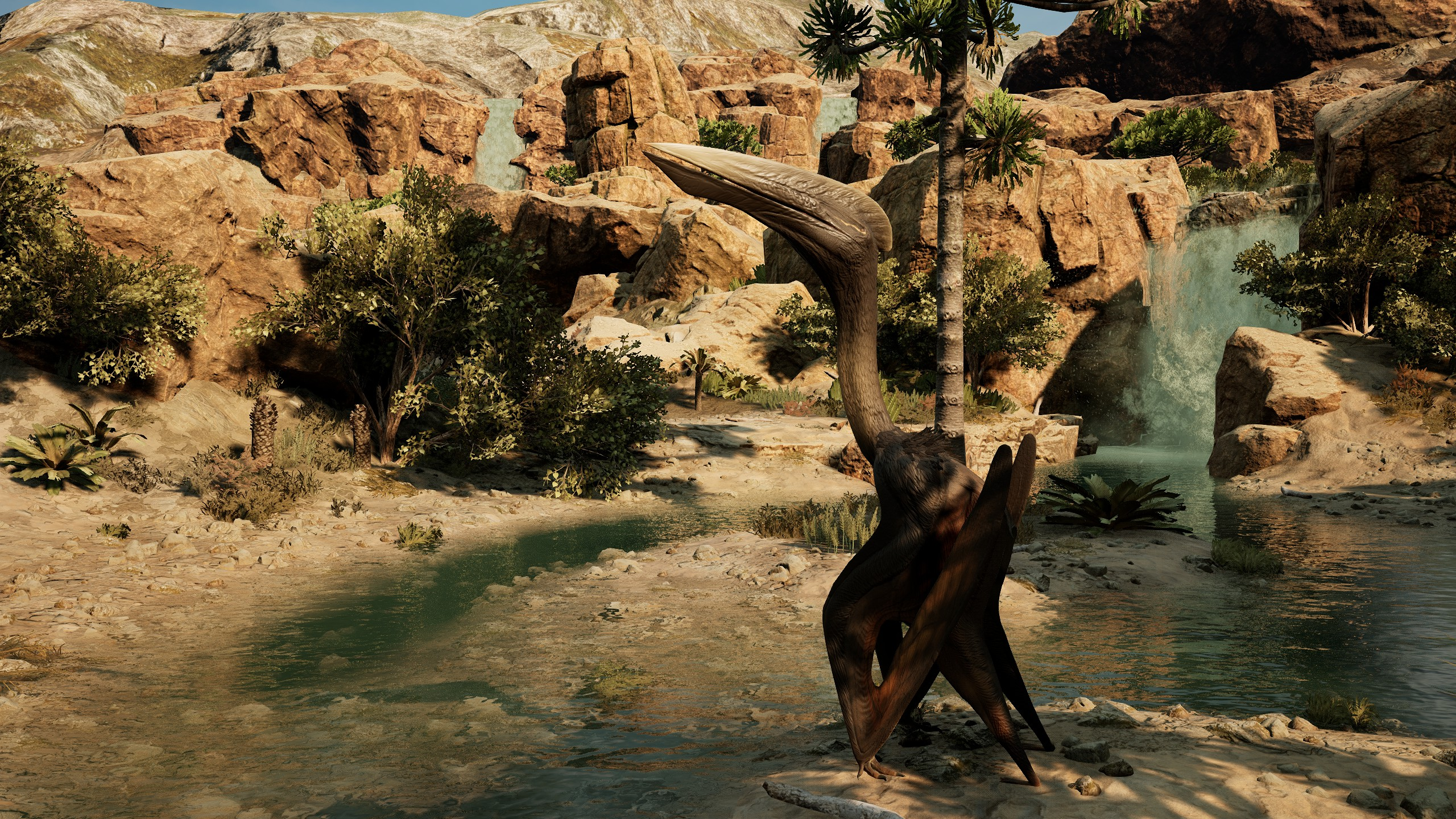
-
Highlights:
- Hatzegopteryx enjoy playing with prey by picking it up and throwing it around.
- Females have favourite nesting spots they return to.
⋆⁺₊⋆ ☀︎ ⋆⁺₊⋆
Group Limits
- Solitary
- Pairs may form to raise offspring, but will separate after.
Nest Limits
- Blooming, Scorching & Wilting Season: 2-3 eggs, 3-hour Interval
- Randomize the amount of eggs during these seasons via bot.
- Frosting Season: 1 egg, 3-hour Interval
- Will nest on cliff edges, never on the ground or in caves.
Sexual Dimorphism
- Sexual Dimorphism is Mandatory.
- Lurk
- Males have brightly coloured crests and throats.
- Tori
- Females are duller, but have brightly coloured wings.
- Mutations
- Both Melanistic and Albino individuals are either abandoned or killed at birth. If they survive, they will almost never succeed in mating.
- Males have a higher chance to mate if they can prove their strength and have battle scars, but it is unlikely.
Habitat
- Nomatic without Offspring
- Territorial with Offspring
- They will stay in one area, normally their nesting site, until the eldest offspring can fly. Then they will return to a Nomadic lifestyle.
- Prefers: Mountainous, Mesa, Hills, Islands, Archipelago, Skerry, Cliff Coast
- Neutral: Valley, Beach
- Dislikes: Marshland, Desert, Woodland
Activity
- Nocturnal
- At Midday, some may wake up to bathe in the water for a bit before going back to sleep. They will not hunt at this time, though will defend their territory if needed.
Diet
- General Carnivore, Food: Aggressive
- Will take any opportunity to hunt, especially small or adolescent species. Hatzegopteryx will chase smaller carnivores off their kills if given the chance.
- Hatzegopteryx will hunt over Hatzegopteryx on low health unless courting / raising chicks.
- May hunt adults / large species on death scars.
- Will never hunt Apex Dinosaurus, even on death scars.
⋆⁺₊⋆ ☀︎ ⋆⁺₊⋆
Growing Behaviours
Hatchling
As soon as offspring hatch, they are noisy and loud. With wings unable to move, and being completely blind, they will squawk loudly for their parents, or huddle up close and sleep.Even at a young age, hatchlings are territorial and will compete for food, pecking at each other when food is smelt nearby. These squabbles are separated by the adults.
Juvenile
Once Hatzegopteryx are juvenile, they may start to wobble around the nest and cliff. They are overseen by a parent as they explore, however, this parent may instead choose to ignore them in favour of sleeping.Hatzegopteryx at this young age are extremely territorial, and will begin to fight, and attempt to push each other off of the cliffside.
If both offspring are strong, the parent will intervene, however if one of them is weak or refuses to fight, the parent might let them die.
Both offspring will choose one part of the nest as their “own”, and will refuse to share it.
If there are more than 2 offspring, one offspring will certainly die. The parents will favour the first born and may ignore the others, or may even pick them up and drop them off somewhere, abandoning them.
Adolescent
Once their wings have developed, Adolescent Hatzegopteryx will walk to the edge of a cliff and start to squeak loudly, before jumping. Some do not make this jump and fall to their death, but most can make it and start gliding down.Parents are very anxious at this time, and may stop the child from jumping before they feel the child is ready.
Once in the air, life rapidly changes for the offspring. As soon as the first offspring is flying, the parents will abandon the nest to go back to their nomadic lifestyle. Offspring are expected to follow the parents independently.
Adolescents will hunt anything they think they can kill, and are very playful as well. They’ll steal objects from other dinosaurs (rocks, flowers, anything), and fly away with it.
The parents will ignore this behaviour, however if the baby tries to steal from them will threaten them away or even attack. This behavior never results in death.
Offspring will disperse if their siblings are extremely hostile, or if there are too many in a clutch before they reach subadult.
Sub/Adult
Once a subadult, the parents will split and fly different ways, either searching for a new mate or a new place to nest. Tori rarely nest in the same spot multiple times. Offspring may choose to follow one of them, however normally they also disperse naturally.This is a dangerous time for subadults, as their siblings, no longer under the protection of parents, will rapidly turn on each other and try to hunt each other down.
Sometimes all the siblings ignore each other and go their own ways in order to explore the now open world.
Rarely, if a sub-adult is almost adult and feeling extremely aggressive, it might go for one of the parents, however this normally happens with the unwanted hatchling if it survives.
Orphan Behaviours
- Orphaned Hatzegopteryx are often left on the ground, and rarely survive. However, those who do survive will remain silent, learning early that any noise may lead to death.
- Unlike their roaming counterparts, orphaned Hatzegopteryx tend to stick to the area they were abandoned in and find a high up place to nest and mate. Tori are especially known to stay in this location until death.
- Orphaned offspring often eat any eggs around them.
Social Behaviours
- Hatzegopteryx are completely solitary outside of mating and rearing.
- They are roamers, travelling the land and being a menace to other species.
- Hatzegopteryx do not like small things, and no matter their hunger may hunt or chase tiny and small dinosaurs, especially the Rhamphorhynchus.
- If with offspring, Adult Hatzegopteryx will grab a tiny / small dinosaur and bring it back to their nest for their children to bully and play with, before killing it.
- Tori tend to stay with offspring to raise them if Lurks leave.
- Lurks are less aggressive then Tori’s.
- When broody and without mate, Hatzegopteryx will pick up stones and other small objects to take back to their nest to sit and brood on.
- Hatzegopteryx love baths, finding small puddles or shallow water and bathing in. However, they hate saltwater. Bathing in saltwater leaves a thick crust all over them.
- Having salt on their wings makes it harder to fly due to the added weight, along with making them look appealing to other Hatzegopteryx’s. Salt water can cause them to develop crust around the bottom of their wings and back (hard to reach places), turning it white.
Interspecies Behaviours
- Hatzegopteryx have a dislike for all dinosaurs, and therefore, will hunt any dinosaur that is younger than adolescent.
- They do, however, enjoy “playing” with small and tiny dinosaurs, picking them up and throwing them around before eating them.
- Hatzegopteryx have a fear of apex dinosaurs, aware one bite may destroy their fragile wings.
- Their favourite meals are Achillobators. When they find a pack, they will stay in the area, hidden until offspring are alone to hunt.
- If Rhamphorhynchus get within 5 bodylengths, or start loudly broadcasting/laughing, Hatzegopteryx will always hunt them, even during the day.
Territorial Behaviours
- Hatzegopteryx defend a 5 body length territory around their nest, however, as soon as their offspring reach subadult, they abandon their nest and start roaming again.
- The expectation of this is abandoned juvi’s, who will stay in the area they hatched for several nesting cycles, or may even never leave.
- Hatzegopteryx have “Favourite Spots”, and when ready to mate and nest, will go to these spots. If something else is there, they will leave for a different spot.
- This behaviour can happen day or night.
Hunting/Hunted Behaviours
- Hatzegopteryx pick up small species or adolescents and below and flying high, before dropping them to their death and scavenging their body.
- Hatzegopteryx will almost always hunt Large or below species that are on deathscars, in which case will peck at them until they die.
- If the Hatzegopteryx reaches 20% health, they will almost always run away.
- They’re known to stalk large groups of dinosaurs for a long period of time, finding herds or nests, and waiting for babies to grow up before hunting them down.
Engagement Limits
- 1 Hatzegopteryx.
Courtship
- Hatzegopteryx enjoy showing off, so both Tori and Lurks will gather around mating locations to find a suitor.
- These locations are: Wind Tunnels and Dry Fang Canyon.
- While Lurks fly above, Tori will try to go to the highest place on the cliff to roost, showing off her wings and will defend this location. Other Tori will come by in order to try to scare her off, often leading to a fight. If neither party backs down, it can easily lead to death. Whichever Tori gives up, must go down a level and find a lower rock to perch on.
- Other Tori may see a spot and aim for weaker Tori’s to push them out of good spots
- Once a Tori has decided on a certain Lurk, she will leap off the cliff and fly just above him. Afterwards, the two will fly in sync for a bit before she takes the lead and lands nearby.
- If any other Tori wish for the same Lurk, they must fight in the air for him.
- Lurks will highly favour the winner, but not always. Colours are incredibly important.
- Once a Tori has won a Lurk, they will both land somewhere and will groom each other, however this gives rival Lurks the opportunity to attack the chosen mate. If he wins, he will leave with her to mate, if someone else wins, she will decide who to mate with.
- Unlike Lurks, Toris prefer strength and have no care for colour.
- Mating for Hatzegopteryx is very dangerous, however, thankfully there are normally only around two in a single location at a time. When a large group does appear, sometimes they separate to go to different locations, or are stubborn and stay in the same place. If so, it is not uncommon to see other carnivore or scavenger species hanging around waiting for bodies to drop.
- Once a pair has courted, they will leave to find a nesting space, normally the Tori’s Favourite Spot. Once nested, they will take turns hunting or drinking. Unless the kill is large, they do not share kills.
- Hatzegopteryx can nest in Wind Tunnels or Dry Fang Canyon, at the risk of their offspring being eaten by other Hatz’s. However it can be a good location, for after a fight for a mate weaker Hatz’s will travel downwards to heal, where the parents can kill them.
- The parents will normally choose a favourite child, and feed them before feeding their siblings.
- They can be very loving, but only towards their favorite child. If they have more than one child, they might abandon the rest or ignore them.
⋆⁺₊⋆ ☀︎ ⋆⁺₊⋆
Notes
- At subadult, the parents must leave the group and separate. Offspring can choose a parent to follow, but once they reach adulthood they cannot group with them.
- Males have a preference for colours unique to each male. Some males prefer colours, some prefer strength.
- Females only care for strength in a potential mate.
- Hatzegopteryx are mean, and purposefully bully all other species except Apex dinosaurs.
- When choosing a nesting location, females take the lead. However, if her favourite spots are taken, the male will take the lead instead.
- Hatzegopteryx hate Rhamphorhynchus.
- Favourite Offspring are normally the firstborn of any clutch, however it can easily change on a dime. They will take the side of the strongest sibling.
- Hatzegopteryx go to Wind Tunnels and Dry Fang Canyon to find a mate. They can nest around these locations, but prefer to not.
Terms
- Lurk = Male Hatzegopteryx
- Tori = Female Hatzegopteryx
- Favourite Spot = Preferred hunting and nesting areas.
- Favourite Offspring = Favourite child.
Stat Changes
- -
⋆⁺₊⋆ ☀︎ ⋆⁺₊⋆